
The role of trace elements in biogas production
“Trace elements are essential for methanogenic processes as they are components of coenzymes used in many reactions leading to methane formation. If their supply is limited, the population’s capacity to synthesize enzymes will also be limited, which in turn undermines the metabolic capacity of the fermenter. Trace elements must not only be present but also in a bioavailable form. A deficiency or low bioavailability of trace elements can result in reduced maximum loads and/or less effective purification. Accumulation and increased volatile fatty acids in the fermenter can be a sign of nutrient deficiency, but if bioavailability and nutrient presence are satisfactory, the possibility of toxicity should be considered.
Although it was known that iron stimulates anaerobic decomposition, this was known before the 1980s when it was found that microelements were insufficient to support activity in fermenters fed with pure culture media. The first identified was nickel, followed by cobalt, and the practical advantages of this were soon noticed: in a survey of industrial wastewater treatment plants, it was noted that 8 out of 30 fermenters, after adding Fe, Ni, and Co, showed increased acetate utilization and methane production rates.
Since then, research consistently demonstrates that adding microelements can be beneficial for the fermentation process for a wide range of feedstocks and types of methanogens. Microelements important in methanogenic metabolism have also been identified and are necessary for the acetogenesis process. General information on where these elements are used in various metabolic pathways is provided in the table.”
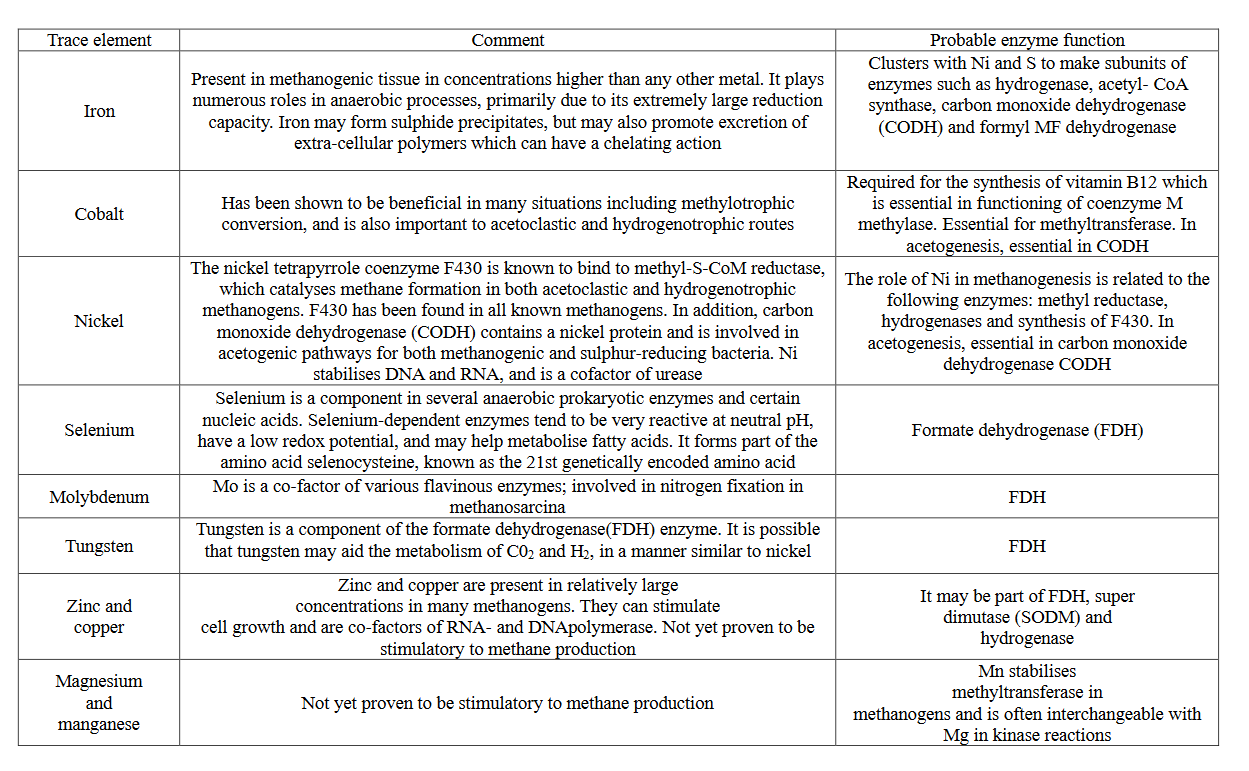 Table – Role of Trace Elements in Methanogenic Processe
It is challenging to provide dosage guidelines for trace elements that would satisfy all cases, as trace elements can form insoluble precipitates with sulfide, carbonate, and phosphate. Elements can remain soluble through chelation (binding with another molecule) but can also strongly bind to the chelating agent, forming complexes that render them unavailable again. Overdosing to try to overcome these limitations is not a good policy, as certain trace elements can be stimulating at low concentrations but toxic at high levels.
While most agricultural methanogens use energy crops as feedstock for co-fermentation with animal manure, this is not always the case. Where monoculture of crops occurs, it may lead to the risk of microelement deficiency or macroelement imbalance. In reality, there are few monosubstrates that can provide the full set of trace elements required for methanogens and syntrophic sugar oxidizers. Therefore, it is not surprising that the addition of Fe, Co, and Ni to methanogens for corn silage fermentation improves biogas yield, while Se and Mo have also been found to be deficient. Microelement deficiency is more likely when agricultural crops or nutrient residues are digested without the manure of ruminant animals. In simpler terms, farmers typically provide dietary supplements to their animals containing the trace elements necessary to stimulate anaerobic consortia in the intestines or the rumen of animals, and most of these elements are excreted in the animal’s feces. Manure may not be seen as a good energy producer in methanogenic processes, but it is undoubtedly an excellent source of those elements that can enhance biogas production.
Some applications of trace elements include disrupting biological processes, uneven biogas production, high organic loads, and unstable feedstock loading. Microelement additives are used in small concentrations and can be introduced manually or through dosing systems.
The application of trace elements allows for reducing the content of short-chain fatty acids, increasing methane content, stabilizing the process, and reducing substrate viscosity. Additional advantages include the ability to work with different feedstocks and increased productivity. An important advantage is that microelement additives do not necessarily have to be used daily and can be applied only when deviations in the production process occur. Furthermore, it is important to remember that microelement additives are not enzymes and can be used additionally to address other issues, such as high ammonia content or foaming. For proper selection of trace elements, you can contact us at +380442092006.
