
Wet milling of wheat
Wet milling of wheat is a process used to extract various components from wheat grains, including starch, gluten, fiber, and other co-products. Unlike dry milling, which is the conventional method used to produce flour, wet milling involves soaking the wheat grains in water before processing.
The wet milling process typically consists of the following steps:
- Cleaning: The wheat grains are thoroughly cleaned to remove any impurities such as dust, stones, and other foreign particles.
- Soaking: The cleaned wheat grains are then soaked in water, usually for a period of 24 to 48 hours. This step helps soften the grains and loosen the outer bran layers.
- Grinding: The soaked wheat grains are ground into a fine paste or slurry. This step helps to break down the grain structure and separate the different components.
- Separation: The ground slurry is passed through a series of sieves, centrifuges, or hydrocyclones to separate the components based on their particle size and density. This process allows for the separation of starch, gluten, fiber, and other co-products.
- Starch extraction: The starch is separated from the slurry using a combination of physical and chemical processes. These processes involve settling, centrifugation, and the use of enzymes and chemicals to separate and purify the starch.
- Gluten separation: Gluten, a protein component of wheat, is also separated from the slurry. This is typically done by allowing the slurry to undergo a natural sedimentation process, followed by further purification steps.
- Fiber recovery: The remaining solids from the separation process, which consist primarily of wheat bran and other fiber components, are collected and dried for use as animal feed or other applications.
The structure of a wheat grain is shown in the figure below:
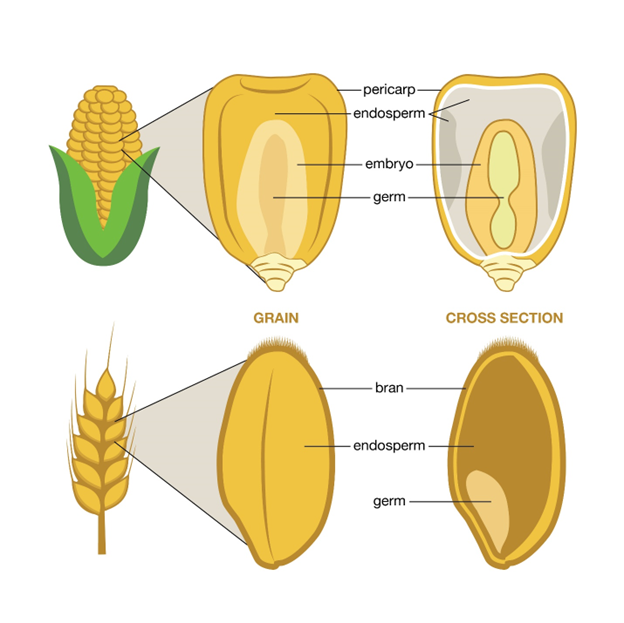
The co-products generated during the wet milling process include wheat starch, gluten, and fiber. These co-products have various applications:
- Wheat Starch: The extracted starch can be used in the food industry as a thickening agent, stabilizer, or for the production of various food products such as noodles, sauces, and bakery items. It can also find applications in non-food industries, including paper manufacturing, textile processing, and pharmaceuticals.
- Gluten: Gluten has unique viscoelastic properties, making it valuable in the food industry for its ability to provide structure and elasticity to baked goods. It is commonly used in the production of bread, pasta, and other wheat-based products.
- Fiber: The fiber-rich co-products, primarily wheat bran, can be used as a dietary supplement or added to food products to enhance their nutritional content. It is also used as animal feed due to its high fiber and nutrient content.
The wet milling technology continues to evolve, with advancements in equipment and processing methods aimed at improving efficiency and product quality. These advancements include automated systems for grain cleaning, improved separation techniques, and the use of enzymes and other additives to optimize the extraction of specific components.
It’s worth noting that while wet milling has its advantages in terms of extracting a wide range of components from wheat, it is not as widely employed as dry milling for flour production, which remains the predominant method due to its simplicity and lower capital costs.
