Wastewater treatment

Implementation of efficient wastewater treatment systems is one of the most crucial steps in preserving the environment.

Wastewater treatment is the process of removing pollutants and contaminating substances from wastewater generated in urban and industrial areas as a result of human activities. Wastewater contains mineral, organic, plant, animal, artificial, and biological substances.

The wastewater treatment process:

  1. Preliminary Treatment. In this stage, wastewater passes through screens that remove large solid particles such as branches and plastics.
  2. Sedimentation. Wastewater enters large reservoirs where solid particles settle down. The formed sludge is separated from the liquid, which proceeds for further treatment.
  3. Biological Treatment. This stage involves the use of microorganisms (bacteria and fungi) that decompose organic matter in wastewater at the biological level.
  4. Chemical Treatment. Chemical reagents are used to remove various pollutants such as phosphates and heavy metals.
  5. Disinfection. In the final stage, wastewater undergoes disinfection, which eliminates bacteria and viruses that might remain after previous treatment processes.

When characterising wastewater, the following terms and concepts are used:

  1. Suspended Solids. These are the contents of solids that can be settled and measured. A conical container called the Imhoff cone with a height of 40 cm is used to determine their quantity. 1 dm3 of wastewater is poured into the cone, and the height of the settled solids is measured after 2 hours of settling.
  2. BOD (Biochemical Oxygen Demand). BOD5 is the biochemical oxygen consumption by bacteria present in wastewater over a 5-day incubation period at 20°C. Before determining BOD5, the initial dissolved oxygen content (8-9 mg O2/dm3) of the sample is measured. Then, after a 5-day incubation at 20°C, the dissolved oxygen content of the sample is measured again, and the difference between the two measurements gives the BOD5 value.
  3. COD (Chemical Oxygen Demand). COD is the chemical requirement for oxygen, which is determined by the oxidation reaction of a strong oxidising agent with organic and inorganic substances in wastewater. Potassium permanganate (KMnO4) or potassium dichromate (K2Cr2O7) is used as a strong oxidant.

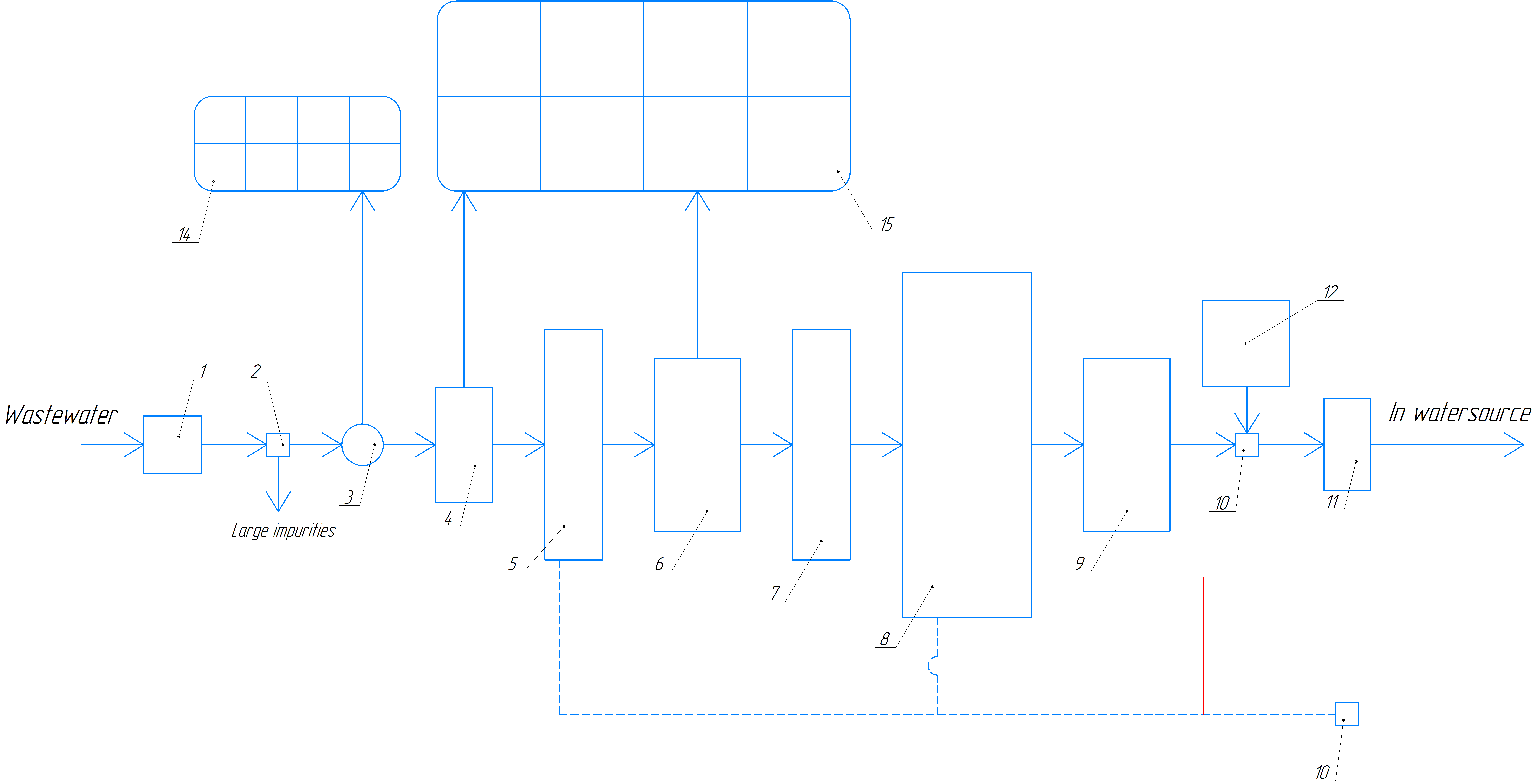
Principle scheme of material flows during biological wastewater treatment:
Mechanical Pretreatment of Wastewater

The scheme involves mechanical and single-stage biological treatment of wastewater from the inlet well. Coarse impurities are removed by a screen made of 8×50 mm steel bars with 12–16 mm spacing, installed at a 60° angle to the wastewater flow. The collected solids are discharged into a collector, while the wastewater passes through a grit chamber and a primary settling tank to remove sand and coarse organic impurities such as malt sprouts and grain particles.

The grit chamber is a cylinder with tangential entry of wastewater. The sediment from the grit chamber is periodically removed to the drying bed 15.

In the primary settling tank, wastewater is partially clarified from suspended solids. It then enters the pre-aerator, where returned activated sludge is mixed with the wastewater and aerated to prevent filamentous bacteria growth and improve flocculation. Fine suspended particles are subsequently removed in the settling tank.

The pre-aerator is equipped with tubular diffusers. At this stage, air consumption is 0.5–1 m³/m³, the activated sludge concentration is 20 g/L, and pre-aeration reduces suspended solids by 30–40% and BOD₅ by 20–25%.

Sludge from the settling tanks is periodically removed to a sludge drying bed, while the clarified wastewater flows to a buffer tank for equalisation before entering the aeration tank.

Biological Treatment and Disinfection

In the aeration tank, wastewater undergoes biological treatment with activated sludge. These tanks have a rectangular shape and consist of two parallel working sections, with a total capacity of 280 m3. Aeration is provided through tubular diffusers with a diameter of 100 mm, using air from the blower station 13. The air consumption per 1 m3 of wastewater is 22…26 m3/h, and the concentration of activated sludge is maintained at 3…3.5 g/L. The biological treatment efficiency is 96% for suspended substances and 95% for BOD5.

The treated effluent goes to the secondary settling tank 9, designed to hold the liquid for 2.5 hours. The activated sludge from the sludge chambers of the tank is removed using a scum lift and returned to the pre-aerator and aeration tank.

Next, the water is mixed with chlorine water in the mixer 10, which is prepared in chlorinators 12, and directed to the contact tank 11. Here, the water is disinfected with chlorine. After a 30-minute retention time in this tank, the treated water is discharged into the river.

Wastewater treatment is a critical process for any production facility to prevent environmental pollution and ensure human health.

RELIABLE
PROFESSIONAL
EFFECTIVE
We combine technical expertise, proven solutions and a comprehensive approach to make every project efficient, reliable and economically justified.
Have a project? Let's start. Questionnaire
044 209 20 06
Mon-Fri: 9am — 6pm
2A Henerala Shapovala st., Kyiv