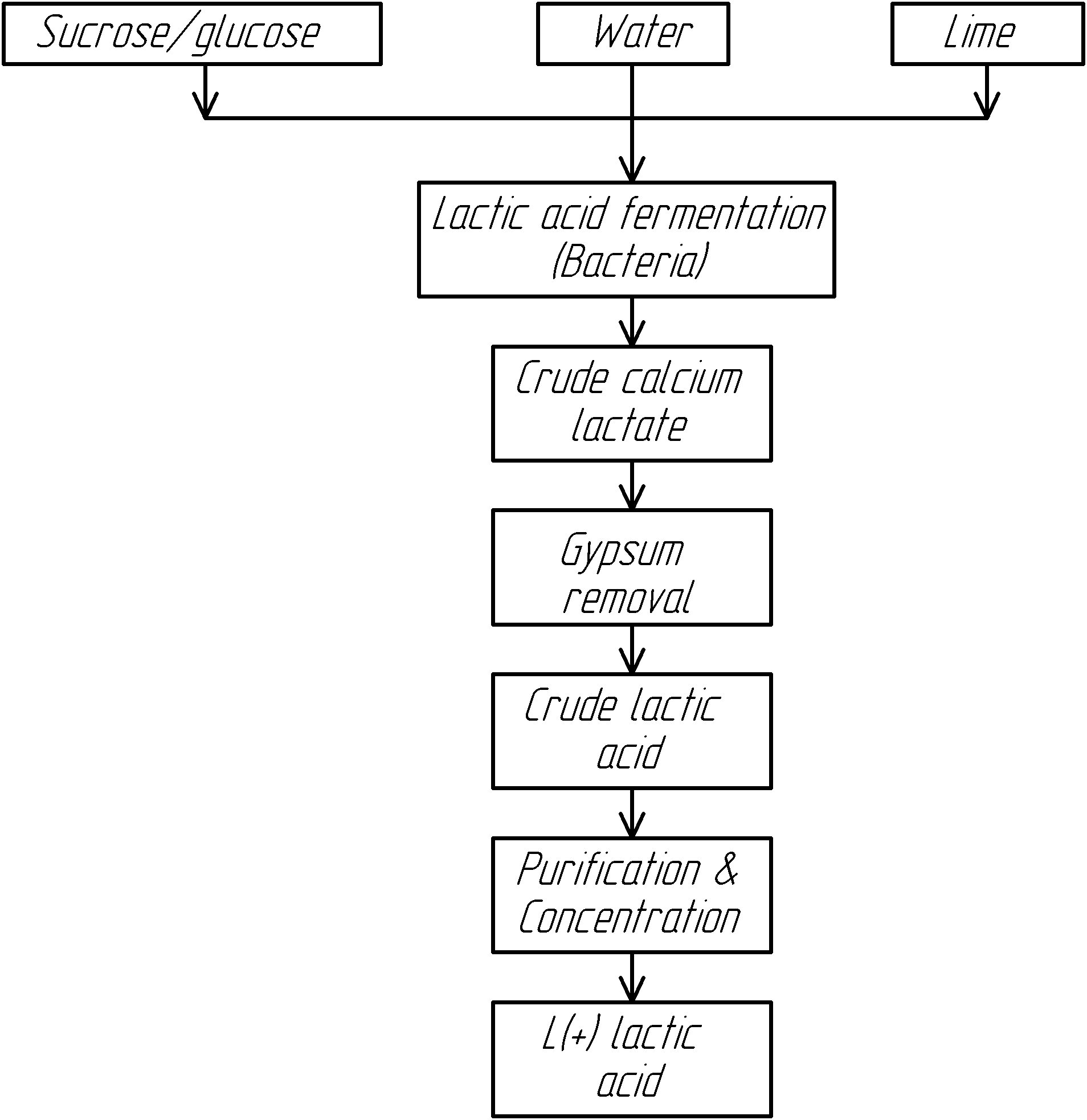
Production of lactic acid
Lactic acid is an organic acid with the molecular formula CH3-CH(OH)-COOH. It is white in its solid state and mixes with water.[2] In a dissolved state, it forms a colourless solution. Its production involves both artificial synthesis and natural sources. Synthetic production occurs in Japan and the USA, while European manufacturers use fermentation methods. European producers contribute approximately 28,000 to 30,000 tons per year to the global production of lactic acid. Lactic acid finds wide application in the pharmaceutical industry (e.g., in isomaltose) and some plastic manufacturing companies.
What is lactic acid?
- Lactic acid is a chemical compound with the formula C3H8O, also known as lactate.
• It is formed during the fermentation of lactose (milk sugar).
• Lactic acid is present in products such as cottage cheese, yoghurt, buttermilk, and kumis.
• It has two optical isomers – L(+) lactic acid and D-lactic acid.
• In 1780, Swedish chemist Carl Wilhelm Scheele first isolated lactic acid from sour milk.
• The solid form of this chemical substance is soluble in water and has a white colour, while the liquid form is colourless.
• Calcium lactate, a soluble salt of lactic acid, can be used as a calcium source.
Properties of lactic acid
C3H6O3 Lactic acid
pH 3.51
Boiling point 122°C
Melting point 53°C
Chemical structure of lactic acid
- It has an acidic functional group (-COOH) and a hydroxyl functional group (-OH). • Despite the presence of the hydroxyl functional group, it exhibits stronger acidic properties. • Due to the presence of an asymmetric carbon atom, lactic acid has two forms: L(+) lactic acid and D-lactic acid. • L-lactic acid is useful as the bodies of animals and humans can metabolise it, whereas D-lactic acid is not metabolised and is excreted from the body. • However, in commercial fermentation, a racemic mixture of D- and L-lactic acid is formed.
Lactic acid is produced industrially by bacterial fermentation of carbohydrates or by chemical synthesis from acetaldehyde. As of 2009, 70–90% of global production was based on fermentation. This process can produce racemic lactic acid (D- and L-isomers in a 1:1 ratio) or high-purity L-lactic acid (up to 99.9%). Industrial production of D-lactic acid by fermentation is also possible but more complex.
Fermentation production
Dairy products are industrially obtained by fermenting milk or whey with bacteria such as Lactobacillus: Lactobacillus acidophilus, Lacticaseibacillus casei (Lactobacillus casei), Lactobacillus delbrueckii subsp. bulgaricus (Lactobacillus bulgaricus), Lactobacillus helveticus, Lactococcus lactis, Bacillus amyloliquefaciens, and Streptococcus salivarius subsp. thermophilus (Streptococcus thermophilus).
Almost any carbohydrate source containing C5 (pentose) and C6 (hexose) sugars can be used for industrial lactic acid production. Common raw materials include sucrose, glucose from starch, raw sugar, and beet juice. Lactic acid bacteria are classified as homofermentative, producing two moles of lactate from one mole of glucose, or heterofermentative, producing one mole of lactate together with carbon dioxide and acetic acid or ethanol.
Chemical production
Racemic lactic acid is synthesised in industry through the reaction of acetaldehyde with hydrogen cyanide followed by hydrolysis of the resulting lactonitrile. When hydrolysis is performed with hydrochloric acid, ammonium chloride is formed as a byproduct. Musashino, a Japanese company, is one of the major manufacturers of lactic acid using this process. Synthesis of both racemic and enantiopure lactic acid is also possible from other starting materials (vinyl acetate, glycerol, etc.) using catalytic procedures.